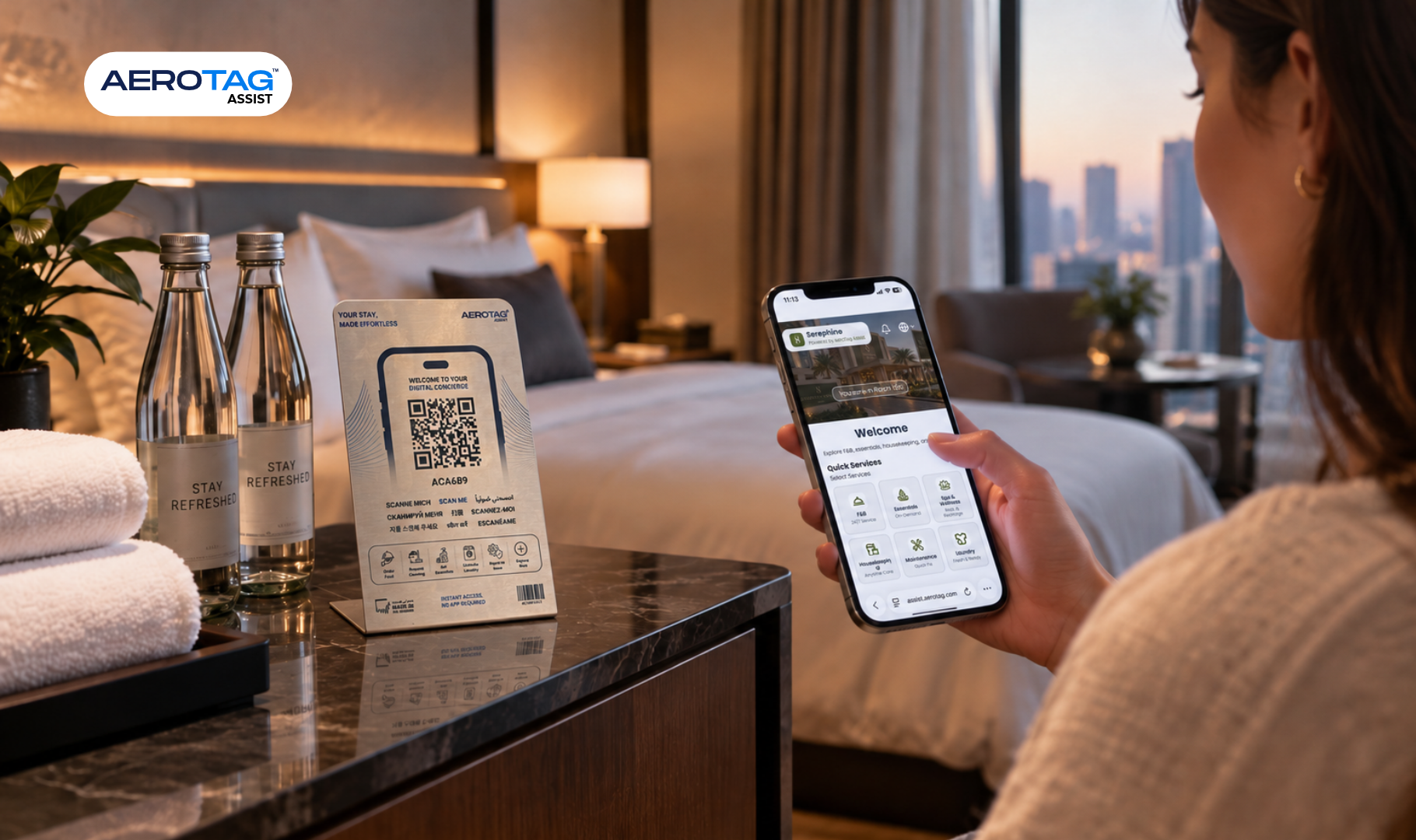
At 10:30 PM, a guest in Room 407 needs two bottles of water.
They call reception. Someone answers, takes the room number and passes the request to the relevant team. A staff member delivers the water.
Nothing went wrong.
But look at the number of people and steps involved in a request that could have taken a few seconds to submit.
Now consider what happens when the requests are not two bottles of water, but extra towels, laundry, maintenance, room service, spa bookings, transportation and restaurant reservations across hundreds of rooms.
This is the operational gap that digital concierge technology is beginning to address.
Why Are Hotels Moving Toward Digital Concierge?
Hotel operators are dealing with a difficult combination of rising labour costs, staffing pressure and higher expectations for convenience.
In February 2025, the American Hotel & Lodging Association reported that 65% of surveyed hotels were experiencing staffing shortages, with housekeeping and front-desk roles among those most affected. Although the survey focused on the United States, the challenge is global: the World Travel & Tourism Council projects that the hospitality sector could face a shortfall of 8.6 million workers by 2035.
At the same time, hotels around the world are facing higher labour costs. With teams under pressure to do more with limited resources, even routine operational tasks deserve attention.
If employees spend part of each shift receiving requests, writing them down, passing them to other teams and checking whether they have been completed, valuable paid time is being spent on coordination. These workflows can potentially be structured digitally, allowing staff to focus more of their time on guests and service
The objective is not to remove employees from the guest journey.
It is to stop employees from being the middleman for every routine request.
Guests Are Already Comfortable With Self Service
There is evidence that hotel guests are becoming more comfortable choosing digital options when they are convenient.
A global Oracle Hospitality and Skift study of more than 5,000 travellers found that 73% were more likely to choose hotels offering self service technology. About 38% preferred a fully self service experience, while 39% wanted to order room service through their phone or a chatbot
That does not mean guests want hotels without people.
It means the guest does not necessarily need an employee for every transaction.
The same principle applies after check in.
If a guest wants to ask about a special experience, resolve a complaint or discuss something unusual, human service matters.
If they need an extra towel, want to report a leaking tap or request laundry, the priority is usually simple: make the request and get it handled.
That distinction is important when deciding where hotel technology should be used.
The Real Problem Is Not the Phone Call
A phone call is not inherently inefficient.
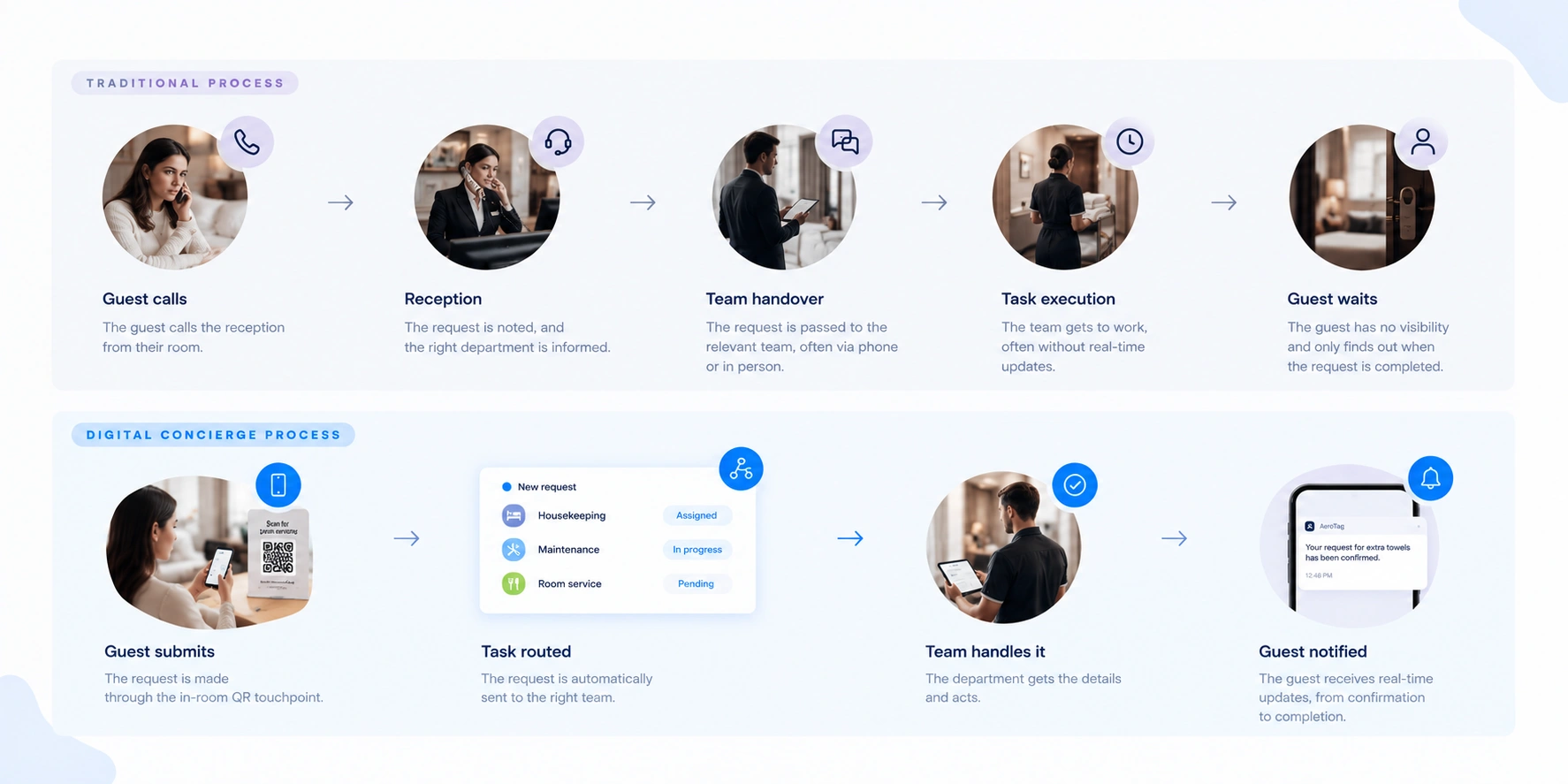
The problem begins when the phone call becomes the system.
A guest calls reception.
Reception communicates with housekeeping.
Housekeeping accepts the task.
Someone completes it.
Someone may need to follow up.
Management may never see the request unless something goes wrong.
At property level, this makes it difficult to answer basic operational questions:
- Which departments are receiving the most requests?
- How many requests are still open?
- How quickly are they being accepted?
- How long does completion take?
- Where are delays happening?
A digital concierge can turn those interactions into structured tasks instead of leaving them as conversations.
That is a much more useful definition of the technology than simply calling it a “digital guest experience.”
What Should a Hotel Digital Concierge Actually Do?
A useful system should connect three things:
Guest request → Hotel team → Management visibility
For the guest, access needs to be simple.
For employees, the request needs to reach the appropriate department.
For management, there needs to be enough visibility to understand what is happening operationally.
The hotel may then use the same interface for services such as:
- Housekeeping requests
- Room service
- Maintenance
- Laundry
- Hotel information
- Spa and restaurant bookings
- Transportation
- Other guest services
This also creates another opportunity.
Your hotel may already have several services that guests can purchase, but front desk employees cannot explain every option to every guest throughout the stay.
A digital interface can put those services in front of guests without requiring an employee to initiate every conversation.
The commercial opportunity should be treated as a secondary benefit, though. The first job is to make the guest’s request easier to complete.
What Does This Look Like in Practice?
This is where Aerotag Assist takes the concept beyond a simple hotel QR code.
The product documentation identifies the original problem as a fragmented process: guests use different channels for different services, while hotel employees have to receive, route, follow up and confirm those requests behind the scenes.
Aerotag Assist puts one access point inside the room.
Through the Aerotag Pulse app, hotel staff can activate the QR touchpoints assigned to each room by simply entering the room number.
If a touchpoint needs to be moved to another room, there is no need to replace the QR code. Staff can simply enter the new room number in the app. The QR code is dynamic, so the same touchpoint can be reassigned whenever needed.
The guest does not need to download a separate app.
They scan the touchpoint and access the hotel’s room specific digital interface.
The physical tag is therefore only the entry point. The operational workflow is what matters.
From request to department
Aerotag Assist is designed so that a guest request can move into the hotel’s workflow.
A housekeeping request can reach housekeeping.
A maintenance request can reach maintenance.
A room service request can reach room service.
Guest → Aerotag Assist → Hotel Team → Management
The Assist 360 dashboard then gives management a central view of tasks, department performance and employee information.
The Assist360 staff app lets employees see the tasks waiting in their queue and choose to accept, reject, or transfer a task to another team member if they’re busy.
That addresses a problem the traditional phone based model does not solve well: knowing what is happening to requests after they are made.
It can also reduce arrival paperwork
Aerotag Passport addresses another part of the guest journey.
Guests can upload their check in documents to the digital wallet, generate a QR code and present it when they arrive. The documents can then be transferred to the hotel’s system.
It is a different use case, but the principle is the same: move a repetitive interaction into a simpler digital process.
The Point Is Not to Make Your Hotel Less Human
This is where hotel leaders need to be selective.
Technology should not replace the moments where human judgement creates value.
It should remove some of the repetitive work surrounding those moments.
A guest with a complaint needs an employee who can listen and solve the problem.
A guest asking for water does not necessarily need a conversation.
A guest wanting a recommendation may want the concierge.
A guest wanting to book a service may simply want to see the available options and make the request.
The goal of digital concierge is therefore quite practical:
Give guests an easier way to ask. Give employees a clearer way to act. Give management a better way to see what is happening.
For a hotel considering technology investment in 2026, that is a more useful question than whether digital concierge is “the future.”
Look at your own operation.
How many routine guest requests still depend on a phone call, a handwritten note, a message passed between employees or someone remembering to follow up?
That is where the business case starts.
Leave a Reply